
Welcome to the Scaling Up Summit playbook!
This playbook will help you design and run a high-impact event for small business entrepreneurs wishing to grow their revenue from 250K€ up to 1M€. You will introduce potential participants to the EOA program in an interactive and engaging way that should capture the attention of potential participants, drive new sign-ups, and position your brand as a key contributor to the Greek entrepreneurial ecosystem. This playbook is particularly useful if your EOA board aims to significantly boost participant recruitment and build a dynamic database of your chapter's EOA program.
The purpose of the Scaling Up Summit
The Scaling Up Summit is a premier event first designed and executing for the
Greek entrepreneurial community by the EO Greece, with three key goals:
-
Educate on Scaling Up: Present entrepreneurs on the 4 pillars of Scaling Up through expert analysis, helping them grow their businesses and make meaningful contributions to the ecosystem.
-
Attract candidates: Engage entrepreneurs who align with the values of EOA and meet the criteria for the EOA program.
-
Increase EO Greece awareness: Boost the recognition of EO & EOA (in our case, in Greece), expanding the influence within the entrepreneurial ecosystem and setting the stage for future events and initiatives.
What is the Scaling Up Summit?
The Scaling Up Summit is designed for business owners and entrepreneurs. During the event, participants will learn about the 4 pillars of Scaling Up — People, Strategy, Execution, and Cash.
The goal is to empower them with actionable strategies to achieve rapid growth in their businesses, concluding with an invitation for participants to apply for the EOA program and join the EOA community.
Section 1: PreEvent Management
Planning & strategy development
-
EOA event committee
Form a dedicated event committee with specific changing roles depending on the following sections:-
pre-event management
-
event execution management
-
post-event managemen
-
-
Define scope
-
Clearly define the Vision, Mission, and Goals of the event.
Example:
Vision: Double the size of the EO Greece Accelerator Program by attracting high-caliber entrepreneurs.
Mission: Create enough leads in order to have a significant pool of prospects for the FY2024/25 intake, as well as a sufficient database, for future use.
Goals: Attract candidates, who are aligned with the EO values and EOA criteria. - Build a strong pipeline of leads for the EOA program
- Expanding the awareness of EO & EOA in Greece, because EO & EOA does not yet have strong brand recognition in Greece.
-
- Define strategy
Use a reverse strategy. Start by answering:
“How many new members to the program do we want?”
Having this as the target, work backward to define necessary steps and metrics based on the local market dynamics, the level of awareness of your EO chapter, market familiarity with the EO program, and the competitive landscape.
These factors will shape how many prospects, event attendees, and leads are needed to hit your target.
Here's how you can approach it:- How many times the target do we need in terms of prospects?
(in our case we aim for at least 3 times the number of the new
members in qualified prospects) - How many times the target do we assume in terms of event
attendees?
(in our case we aim for at least 6 times the target number in event
attendees) - How many times the target do we need in terms of leads?
(in our case we aim for at least 25 times the target number in leads
generated)
Example:
Objective: Achieve 40 EOA program participants for the year 2023-2024
We already have 19 EOA members, and we need to recruit 21
more to reach our target.
To achieve these 21 new members, we define the following
metrics:- At least 63 new prospects.
- At least 126 attendees in the event (direct contact with leads
at the event). - Almost 525 leads (a registration with their name, email, phone)
- 155.000 ads views
- How many times the target do we need in terms of prospects?
- Budget
One of the main challenges and the first question to answer is:
“Where do we find the money for this?”
The Scaling Up Summit is a critical event designed to recruit a big number of new participants, promote brand awareness, and establish a pipeline of prospects for future programs. To ensure the event's financial viability, it is essential to develop a clear, precise budget. This budget balances the projected costs with the expected returns, focusing on key financial metrics, including Customer Acquisition Cost (CAC), Customer Lifetime Value (CLTV),
and overall Return on Investment (ROI).
Here’s a process:
Step 1: Define event goals and target outcomes
Question: What is the primary objective of the event?
- How many new participants do you aim to acquire
from the event?
Example: In our case we define the target number of new
participants to 20 participants.
Step 2: Calculate the participants lifetime value (CLTV)
Question: What is the total value each new participant brings to
the organization over time?
- What is the expected revenue from each
participant over their lifetime in the program?
- How long is a participant expected to stay in the
program (e.g., 3 years)?
Example: If each participant pays as local fees 800€ per year
and stays for 3 years, the CLTV is:
CLTV = 800 × 3 = 2,400 €
This helps determine the financial impact of each new
participant.
Step 3: Estimate the Event Costs
Question: What are the total projected costs for the event?
- What is the budget for venue, catering, marketing,
and logistics?
- What costs are covered by sponsorship?
Example: In our case we break down the costs, including those
paid by your budget and covered by sponsorship.
Step 4: Calculate the Customer Acquisition Cost (CAC)
Question: How much does it cost to acquire each new
participant?
- What is the total event cost divided by the number
of participants you aim to acquire?
Example: In our case we use the CAC to calculate how much it
costs to acquire one participant.
if the total event costs are €7,000 and you aim to
acquire 20 participants, the CAC is:
CAC= 7,000 / 20 = 350,00
Step 5: Compare CAC to CLTV
Question: Is the CAC lower than the CLTV?
Example: we compared the CAC (350,00€) to the CLTV
(2,400,00€). In this case, the CLTV is higher than the
CAC, indicating that acquiring each customer
through the event generates a significant positive
return.
Step 6: Calculate the Break-Even Point
Question: How many participants do we need to cover the
event costs?
- How many new participants must be acquired to
break even on the event expenses?
Example: if the total event costs are €7,000 and the CLTV per
participant is €2,400, we need:
Break-even Participants
7.000,00 / 2.400,00 = 3 participants
Step 7: Calculate the Return on Investment (ROI)
Question: What is the overall return on investment (ROI) for the
event?
- What is the total profit generated by the event
relative to the costs incurred?
Example: In our case we aim to recruit 20 participants, each with
a CLTV of €2.400,00, and the total event cost is
€7.000,00:
ROI = [[(20 × 2.400,00) – 7.000,00] / 7.000,00] × 100 =
= 585,71% (nearly 6 times the return in revenue)
A 585.71% ROI means that EOA Greece expects to
generate nearly six times the return for every euro
spent. -
Sponsorship and Partnerships
Sponsorship is the cornerstone of the event's success and provides a
strong boost, especially for the first event. To support your event and reach a larger audience, partner with sponsors and strategic alliances who align with EO values. Sponsors can help cover costs for marketing, food, and speakers, and strategic partnerships with entrepreneurial organizations can increase event visibility.
Be creative in finding the right sponsors—companies whose products or services appeal to the same target audience but from a different, complementary perspective—one that will ensure they supplement the EOA program and don't directly compete against it. These sponsors should ideally add value to the target audience by offering something unique, such as tools, services, or experiences designed to support the entrepreneurial journey in ways that don't overlap with the core offerings of the EOA program.
What the sponsor will gain:
Brand
exposureSponsors receive visibility in all pre-event promotions (social media, email campaigns, website) and during the event (branded stages, banners, presentations). Audience
engagementSponsors gain direct access to a qualified audience of entrepreneurs and business owners through networking sessions, panels, or workshops. Data &
insightsProvide sponsors with access to data on event participants (with consent)
-
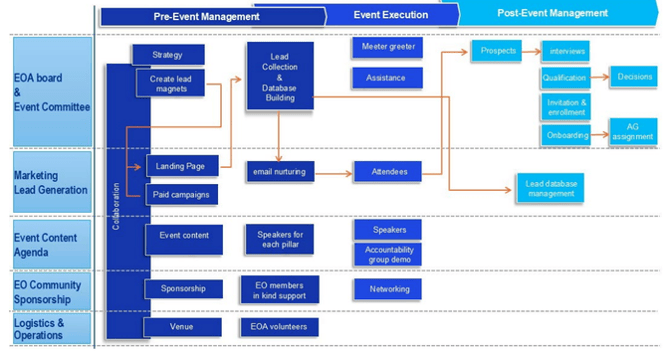
The process
-
High-level timeline
- This is an indicative timeline which helps with planning, coordination,
and tracking progress.- 8 weeks before the event:
- Form the event committee and define event goals.
- Begin outreach for sponsors and partnerships.
- Create landing pages, lead magnets, and sales funnel assets.
- 6 weeks before the event:
- Launch paid ad campaigns and email nurturing sequences.
- Develop the event agenda and confirm speakers.
- 4 weeks before the event:
- Secure the venue and handle logistical arrangements.
- Finalize event materials (e.g., presentations, banners).
- 1 week before the event:
- Send reminder emails to leads and confirm attendance.
- Review all event day logistics.
- Event day:
- Execution of the agenda, manage speaker sessions, and facilitate networking opportunities.
- On-site support for attendee networking and questions.
- Post-event (1-2 weeks after):
- Conduct follow-up communications with prospects.
- Onboarding successful applicants to the EOA program.
- Review event KPIs and success
- 8 weeks before the event:
- This is an indicative timeline which helps with planning, coordination,
How to generate leads
-
Sales funnel design
Messaging focus:
Use a power statement like “How to grow your business from €250K to €1M in 3 years” to capture attention.
Develop clear KPIs for lead generation.
For example:
● KPI 1: Reach 10,000 views.
● KPI 2: Collect at least 500 qualified leads (name, email, phone).
● KPI 3: Convert 120 leads into event participants.
● KPI 4: Convert 60 participants into viable prospects. - Sales funnel assets
Develop key marketing and sales assets to attract, engage, and convert leads. Use a marketing automation platform (e.g. ActiveCampaign, Brevo) for managing the following assets:
Paid ads Use ads that feature the key promise of scaling up a business, alongside EO/EOA branding to establish credibility Sample: Publication list (expect FB, Linkedin, Instagram) here
Ads Creative here
Post samples hereLanding
pageCreate a landing page that showcases the 4 pillars of
Scaling Up and explains the value of attending the
summit. The page should also highlight EOA values
and include a call to action to register for the event.Sample: Landing page in English (with auto translation by google) here
Landing page in Greek hereLead
magnetsOffer valuable resources like eBooks, guides, or case studies to prospects in exchange for their contact information. Sample: eBook in English here Email
nurturing
campaignBuild a follow-up email sequence that gradually educates leads on the EOA program, scaling methodologies, and event details. Make sure each email adds value by focusing on the entrepreneur’s
pain points and how Scaling Up can help.
Develop three categories of emails:
1. Thank you email
2. Scaling Up insights emails
3. Event-focused emailsSample: Nurturing email list here
Thank you email sample here
Scaling Up Insights email sample 01 here
Scaling Up Insights email sample 07 here
Event-focused email sample 11 here - Event content and agenda
Focus on how the EOA program helps entrepreneurs scale their businesses while aligning with its core values of learning, growing, and giving back.
Use case studies and testimonials to establish credibility.
Leave space for networking
Sample: You can find a sample of agenda here
Section 2: Event Execution Management
How to execute the event
-
Venue
The venue for the Scaling Up Summit should inspire growth andcollaboration.
Choose a location with a modern amphitheater to create an environment where groundbreaking ideas can be shared, and attendees can feel energized.
Around the amphitheater, it provides dedicated spaces for networking, allowing participants to connect and build meaningful relationships.
Between sessions, there should be comfortable areas for snacking and coffee breaks, offering a chance for attendees to relax and engage in informal conversations. -
Venue logistics
The event execution phase involves smoothly handling all logistical and
operational aspects to ensure a successful event. This includes:Stage setup Ensure a professional setup for speakers and panelists Speaker lineup Bring in industry experts to talk about the
4 pillars of Scaling Up and their real-life business experiencesNetworking
opportunitiesBuild plenty of time for attendees to network with each other and EO members. On-site
managementHave a dedicated team to manage registrations, event flow, and guest inquiries. -
A Day at the Scaling Up Summit
Tap below and immerse yourself in
Section 3: Post Event Management
How to recruit, enroll, onboard EOA members
-
Define selection criteria
To select the right candidates, it's critical to target entrepreneurs who meet
the following criteria:Fit for the
ProgramIs the entrepreneur currently generating €250K to €1M in revenue and looking to scale? Scaling Up
potentialHas the entrepreneurs' business model/line potential for growth and scalability? EOA Values
AlignmentDoes the candidate share EO’s ethical s0tandards, commitment to growth, and passion for community? - Recruitment, enrolment and onboarding processes
EOA Greece has documented the recruitment, enrolment and onboarding processes, as following:- Stage 1: Lead generated registration & initial contact
- New leads generation led by the ΕΟΑ Marketing Chair.
- The Membership Chair sends typeform questionnaire to new leads (including referrals by EOers / Accelerators / Others).
- The Membership Chair maintains the prospect list, in EOA Master Document.
- The Membership Chair makes initial contact (phone call / online call / in person meeting) with the prospect, for screening.
- The Membership Chair updates the prospect list with comments and info about the prospect.
- If necessary, the Accelerator Chair can have extra communication with the prospects and then update the prospect list with relevant comments.
- Stage 2: Qualification and decision-making
- The Membership Chair suggests to the Board the prospects that are qualifying, and the Board makes the final decision, based on all the info available in the prospect list.
- The Membership Chair updates the prospect list with qualified and disqualified prospects.
- The Membership Chair sends email, informing disqualified prospects and updates the prospect list.
- Stage 3: Invitation and enrollment
- The Membership Chair sends an invitation to join the EOA Program to approved prospects, copying Chapter Manager and updates the prospect list, with the sent date.
- Once the prospect accepts the invite to join EOA Program, the Chapter Manager sends the enrollment process and updates the prospect list, with the sent date.
- If the prospect does not apply or reply, the Chapter Manager sends 1 reminder and updates the prospect list.
- Once the prospect submits their application in EO hub, the Chapter Manager updates the participants' list in master doc, with all available info.
- The Chapter Manager makes sure that local fees have also been paid - if not sends relevant reminders to applying members and updates the participants list.
- Stage 4: Onboarding new EOA members
- When the applying member becomes a full EOA member, the Chapter Manager updates the participants list and informs the EOA Board.
- The Chapter Manager sends new EOA members the onboarding email, with all necessary info and logistics, copying the Accelerator Chair and AG Chair.
- The Chapter Manager adds new EOA members to slack and relevant private slack channels and to NL recipients list and informs the Board that new members are in slack.
- The Comms Chair invites new EOA members to introduce themselves in the relevant slack channel.
- The AG Chair adds the new EOA member to an AG, considering their industry and avoiding possible conflicts.
- The Chapter Manager adds the new member to their AG group on EO network.
- The Chapter Manager adds the new member to the relevant AG group tracker.
- The AG Chair connects the new member with their AG Coach and provides them with all explanatory material about the AG functions [e.g. a video of AG trackers explained can be found here (in Greek)].
- Stage 5: AG assignment and final onboarding
- The AG Coach boards the new member to their AG group.
- Stage 1: Lead generated registration & initial contact
- Curation of the above-mentioned documents
- The typeform questionnaire comes from the depths of time and is based on the prospects’ questionnaire that EO Greece uses for screening prospects.
- The prospect list google sheet in EOA Master Document, was initially created by the EOA Board FY2021/22 and has been maintained since.
- The Accountability Groups google sheet was created by AG Chair 2024/25 and was based on the similar google sheets, created by AG Chairs 2022/23 & 2023/24.
- The AG tracker explanatory video was created by the AG Chair 2024/25 and was based on similar videos, created by AG Chairs 2022/23 & 2023/24.
- Intake process tracker
Following the Scaling Up Summit, ΕΟ Greece Chapter Manager designed and tracked the intake process using monday.com.
Sample of the tracker can be found here.
The tracker has integrated the Slack app, for informing the EOA Board Channel with the prospects’ status, that involves actions done in Slack (e.g. new EOA member joined Slack, Comms Chair needs to invite them to introduce themselves in EOA introduction slack channel).
The tracker had a number of automations, for indicating the next steps in the process with relevant notifications and for sending automated emails to prospects (e.g. enrolment process).